Ages Without Apps
Short · October 11, 2026
How Did Egyptians Cut Granite Without Power Tools?
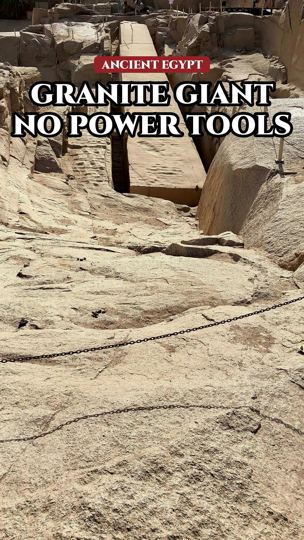
How did Egyptians cut granite without power tools? The best evidence is still lying in the quarry at Aswan: the unfinished obelisk.
Key facts about how did egyptians cut granite
- It is 41.75 metres long, and when Reginald Engelbach cleared it in 1922 he calculated that, finished, it would have weighed about 1,168 English tons.
- Cracks (fissures) in the granite appeared as the work went on, and it was abandoned in the bedrock.
A note on the evidence
- How the quarrymen worked, from Engelbach's study: the rock surface was first brought down to level by burning (stacks of dried reeds banked with brick, so the heated granite could be hammered away) and wedging. The trench around the obelisk shows no chisel marks and no copper tools were found; instead the quarry is full of balls of dolerite, 9 to 15 lb (about 4 to 7 kg), a stone far tougher than granite. Crews pounded the granite to dust along a trench about 75 cm wide, and red lines painted on the walls were probably depth marks. When Engelbach tried pounding by hand himself, an hour's hard work removed about 5 millimetres. He estimated the whole trench would have taken about seven months, close to the seven months Queen Hatshepsut's inscription gives for quarrying her obelisks.
Sources for how did egyptians cut granite
- R. Engelbach, The Aswan Obelisk, with some remarks on the ancient engineering (Cairo: Service des Antiquités de l'Égypte, 1922), sections 8, 12-15 (size and weight, burning, pounders, trench, red lines, hand pounding test, time estimate)
- R. Engelbach, The Problem of the Obelisks, from a study of the unfinished obelisk at Aswan (London, 1923)
Images: the colour photos of the unfinished obelisk were taken in 2002 and 2019 and released CC0 on Wikimedia Commons. The black and white view is Engelbach's own photograph just after he excavated it, published in 1922. The diagrams are our own simplified drawings (the size diagram is to scale).
Questions people ask
What are the key facts: how did egyptians cut granite?
It is 41.75 metres long, and when Reginald Engelbach cleared it in 1922 he calculated that, finished, it would have weighed about 1,168 English tons. Cracks (fissures) in the granite appeared as the work went on, and it was abandoned in the bedrock.
Is any of this disputed or uncertain?
How the quarrymen worked, from Engelbach's study: the rock surface was first brought down to level by burning (stacks of dried reeds banked with brick, so the heated granite could be hammered away) and wedging. The trench around the obelisk shows no chisel marks and no copper tools were found; instead the quarry is full of balls of dolerite, 9 to 15 lb (about 4 to 7 kg), a stone far tougher than granite. Crews pounded the granite to dust along a trench about 75 cm wide, and red lines painted on the walls were probably depth marks. When Engelbach tried pounding by hand himself, an hour's hard work removed about 5 millimetres. He estimated the whole trench would have taken about seven months, close to the seven months Queen Hatshepsut's inscription gives for quarrying her obelisks.
Where can I check the sources?
This page lists 2 sources, including: R. Engelbach, The Aswan Obelisk, with some remarks on the ancient engineering; R. Engelbach, The Problem of the Obelisks, from a study of the unfinished obelisk at Aswan.
Where can I watch the video?
The Short is on the Ages Without Apps YouTube channel, and you can watch it on this page.
Enjoyed this story?
Subscribe for the next one.