Ages Without Apps
Short · October 18, 2026
Coat of Plates: How Soldiers Wore Armor Without Showing It
Coat of plates: how did medieval soldiers wear steel armor without it showing? A coat of plates was a cloth or leather coat with small overlapping steel plates riveted inside it.
Key facts about coat of plates
- The mass graves from the Battle of Visby in 1361 hold at least 24 different designs, with up to about 600 plates in one coat.
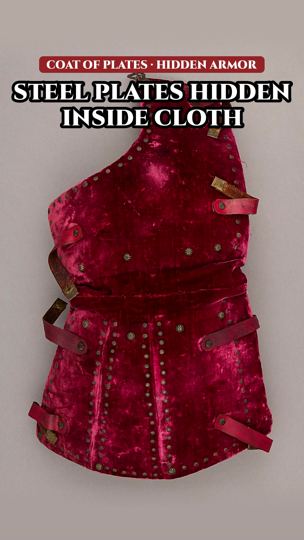
- From outside the coat could look like plain cloth, and fancy ones were covered in velvet.
A note on the evidence
- What is solid and what is debated: Solid: a coat of plates is small steel plates riveted inside a cloth or leather garment (Oxford Encyclopedia of Medieval Warfare, as summarised in the encyclopedia article cited below; the Met describes the related brigandine as torso armor of small plates riveted to layers of fabric, some still with their velvet covering). Solid: the Visby mass graves (Gotland, Sweden, battle of 1361) gave the best surviving examples, with 8 to about 600 plates per coat and at least 24 different patterns (Thordeman, Armour from the Battle of Wisby, 1361, 1939). Debated or hedged: how much of the plates showed from outside. Coats of plates are described as plates riveted inside a cloth or leather garment (Smith 2010 and Williams 2003, via the encyclopedia summary), and for the Visby gauntlets Thordeman noted rivets on the outside, showing the plates were fastened to a covering. The covers mostly survive only as traces, and rich covers like velvet are known mainly from later brigandines. The video says "probably looked like plain cloth" for that reason. The "stiff and hard to make" solid shell comparison comes from Matthias Goll's 2013 thesis on segmented armour (cheaper, lighter and more flexible, with fewer tools and skill needed); that is one scholar's argument, not a universal rule. The number of dead at Visby is not stated in the video because accounts differ. Not a coat of plates: the red velvet armor and the plate sections shown from the Met are Italian brigandine parts from the Chalcis find, c. 1400 and later. Brigandines are the later cousin of the coat of plates. They are labelled that way on screen.
Sources for coat of plates
- Historiska museet (Swedish History Museum), "Medieval Massacre": the 1361 clash on Gotland, mass graves excavated in the 1920s, extremely well preserved armour, and the mobility of the plates
- Bengt Thordeman, Armour from the Battle of Wisby, 1361 (Kungl. Vitterhets Historie och Antikvitets Akademien, Stockholm, 1939), the standard publication of the finds; reviewed in The Antiquaries Journal
- Thomas Neijman, "Armament," in The Battle of Visby 1361 and Its Contemporary Heritage (Boydell, 2021)
- The Metropolitan Museum of Art, Coat of Plates, or Brigandine, Italian, c. 1400 (29.150.105), and Brigandine Armor, c. 1400 and later (29.150.91)
- Coat of plates (encyclopedia summary citing Smith 2010 and Williams 2003, Visby plate counts and Goll 2013)
Images: public domain archive photos from the Swedish National Heritage Board (Riksantikvarieämbetet, via Wikimedia Commons) of armour from the Visby mass graves, dated on screen (photos from 1905, 1931 and 1936); CC0 Met Open Access photos of Italian brigandine parts (c. 1400 and later), labelled as brigandines. The two diagrams are our own simplified drawings. Sound effects and music: our own synthesized sounds and composition plus public domain sounds.
Questions people ask
What are the key facts about coat of plates?
The mass graves from the Battle of Visby in 1361 hold at least 24 different designs, with up to about 600 plates in one coat. From outside the coat could look like plain cloth, and fancy ones were covered in velvet.
Is any of this disputed or uncertain?
What is solid and what is debated: Solid: a coat of plates is small steel plates riveted inside a cloth or leather garment (Oxford Encyclopedia of Medieval Warfare, as summarised in the encyclopedia article cited below; the Met describes the related brigandine as torso armor of small plates riveted to layers of fabric, some still with their velvet covering). Solid: the Visby mass graves (Gotland, Sweden, battle of 1361) gave the best surviving examples, with 8 to about 600 plates per coat and at least 24 different patterns (Thordeman, Armour from the Battle of Wisby, 1361, 1939). Debated or hedged: how much of the plates showed from outside. Coats of plates are described as plates riveted inside a cloth or leather garment (Smith 2010 and Williams 2003, via the encyclopedia summary), and for the Visby gauntlets Thordeman noted rivets on the outside, showing the plates were fastened to a covering. The covers mostly survive only as traces, and rich covers like velvet are known mainly from later brigandines. The video says "probably looked like plain cloth" for that reason. The "stiff and hard to make" solid shell comparison comes from Matthias Goll's 2013 thesis on segmented armour (cheaper, lighter and more flexible, with fewer tools and skill needed); that is one scholar's argument, not a universal rule. The number of dead at Visby is not stated in the video because accounts differ. Not a coat of plates: the red velvet armor and the plate sections shown from the Met are Italian brigandine parts from the Chalcis find, c. 1400 and later. Brigandines are the later cousin of the coat of plates. They are labelled that way on screen.
Where can I check the sources?
This page lists 5 sources, including: Historiska museet; Bengt Thordeman, Armour from the Battle of Wisby, 1361; Thomas Neijman, "Armament," in The Battle of Visby 1361 and Its Contemporary Heritage.
Where can I watch the video?
The Short is on the Ages Without Apps YouTube channel, and you can watch it on this page.
Enjoyed this story?
Subscribe for the next one.