Ages Without Apps
Short · October 17, 2026
How Did People Shave Before Razors Without Steel?
How did people shave before razors? Not with steel. Copper changed that, because a copper blade can be sharpened again.
Key facts about how did people shave before razors
- Ancient Egyptians were buried with razors of copper and even gold, and earlier people probably scraped hair off with sharp flint, shells or shark teeth, tools that dull fast and were likely thrown away after a few shaves.
- Traveling barbers worked in Egypt, so many men probably never owned a razor, and Romans sometimes plucked hair out by the roots instead.
- Britannica dates the first copper and gold razors in Egyptian tombs to the 4th millennium BCE, more than 5,000 years ago.
A note on the evidence
- What is solid and what is debated: Solid: copper and gold razors were buried in Egyptian tombs (Britannica; a copper razor from a Predynastic grave at Dakka in Nubia, c. 3850 to 3650 BCE, is in the Museum of Fine Arts, Boston). Debated: whether flint, obsidian, clam shells and shark teeth were really used to shave. Britannica says prehistoric cave drawings show them used as shaving tools, but UCL's museum researchers call flint and obsidian "an option" only, and Egyptian flint "razor blades" may have been grave goods, so their real use is still unproven. The line "probably used" in the video reflects that. Plucking: Roman evidence comes from the poet Martial, as discussed by UCL.
Sources for how did people shave before razors
- Britannica, "razor" (clam shells, shark teeth and sharpened flints as early shaving tools; solid gold and copper razors in Egyptian tombs of the 4th millennium BCE; razors in Rome)
- Britannica, "shaving"
- UCL Researchers in Museums, "Question of the Week: How did men in antiquity shave?" (Petrie Museum copper alloy razors, Old Kingdom, c. 2686 to 2181 BCE; flint and obsidian blades discarded after a few uses; traveling barbers; plucking in Martial, Epigrams 9.5.4)
- Jakub Skłucki, use wear analysis of flint razor blades at Tell el Farkha, 2025 (copper and gold razors with flint "razor blades" in the tomb of Hetepheres at Giza; their use is not yet properly researched)
- Museum of Fine Arts, Boston, copper razor, Predynastic Naqada I, 3850 to 3650 BCE, Dakka, Nubia
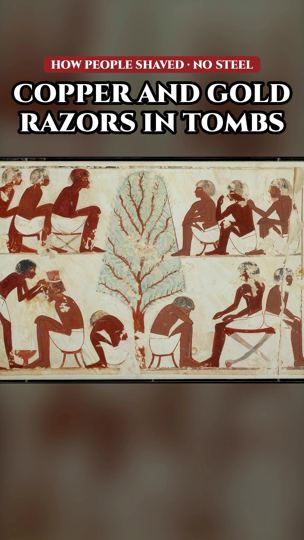
Images: public domain and CC0 museum photos and artworks, each labelled on screen with its date (copy of the Userhat tomb painting, c. 1427 to 1400 BCE; photo of the sarcophagus of Queen Hetepheres, c. 1925; copper alloy razors and a cosmetic set from Egypt, 1950 to 1353 BCE; a flint blade tool, c. 4500 to 4000 BCE; a Cycladic obsidian blade, c. 2700 to 2200 BCE; Roman bronze tweezers, 1st to 2nd century CE). The flint and obsidian pieces are not shown as razors. The razors shown from the Turin and Met collections are later than the first Egyptian razors, and are labelled that way. The diagram and cards are our own simplified drawings. Sound effects and music: our own recordings and compositions plus public domain sounds.
Questions people ask
What are the key facts: how did people shave before razors?
Ancient Egyptians were buried with razors of copper and even gold, and earlier people probably scraped hair off with sharp flint, shells or shark teeth, tools that dull fast and were likely thrown away after a few shaves. Traveling barbers worked in Egypt, so many men probably never owned a razor, and Romans sometimes plucked hair out by the roots instead. Britannica dates the first copper and gold razors in Egyptian tombs to the 4th millennium BCE, more than 5,000 years ago.
Is any of this disputed or uncertain?
What is solid and what is debated: Solid: copper and gold razors were buried in Egyptian tombs (Britannica; a copper razor from a Predynastic grave at Dakka in Nubia, c. 3850 to 3650 BCE, is in the Museum of Fine Arts, Boston). Debated: whether flint, obsidian, clam shells and shark teeth were really used to shave. Britannica says prehistoric cave drawings show them used as shaving tools, but UCL's museum researchers call flint and obsidian "an option" only, and Egyptian flint "razor blades" may have been grave goods, so their real use is still unproven. The line "probably used" in the video reflects that. Plucking: Roman evidence comes from the poet Martial, as discussed by UCL.
Where can I check the sources?
This page lists 5 sources, including: Britannica, "razor"; Britannica, "shaving"; UCL Researchers in Museums, "Question of the Week: How did men in antiquity shave?".
Where can I watch the video?
The Short is on the Ages Without Apps YouTube channel, and you can watch it on this page.
Enjoyed this story?
Subscribe for the next one.