Ages Without Apps
Short · October 3, 2026
Roman Concrete Self Healing: Why It Lasted 2,000 Years
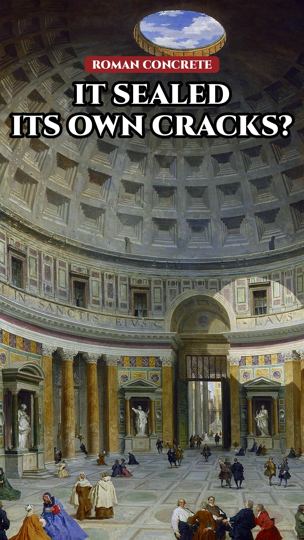
Why has Roman concrete lasted 2,000 years? Part of the answer may be that it could seal its own small cracks.
Key facts about roman concrete
- A 2023 MIT led study found the little white lumps in Roman concrete, called lime clasts, were not sloppy mixing: the Romans likely mixed in quicklime hot.
- When water seeps into a crack, that lime can dissolve and harden again as calcium carbonate, filling the gap.
- Roman style test blocks sealed their cracks within weeks, while modern style blocks did not.
- In harbour walls, seawater reacting with volcanic ash grew new minerals inside the concrete, just as Pliny the Elder wrote: "every day stronger."
Sources for roman concrete
- Seymour, L.M. et al., "Hot mixing: Mechanistic insights into the durability of ancient Roman concrete," Science Advances 9(1), eadd1602 (2023)
- MIT News, "Riddle solved: Why was Roman concrete so durable?" (6 Jan 2023)
- Science News, "Chemists may have finally figured out why Roman concrete was so durable" (2023)
- Jackson, M.D. et al., "Phillipsite and Al tobermorite mineral cements produced through low temperature water rock reactions in Roman marine concrete," American Mineralogist 102 (2017)
- Pliny the Elder, Natural History 35.166 (quoted in Jackson et al. 2017)
Images: the Pantheon views are later depictions (Panini's painting c. 1734 and Piranesi's 18th century etchings); the harbour etching is Piranesi's imagined Roman port (c. 1750); the coin is an ancient sestertius of Nero (AD 54 to 68) showing the port of Ostia; the Pozzuoli view is from 1776.
Questions people ask
What are the key facts about roman concrete?
A 2023 MIT led study found the little white lumps in Roman concrete, called lime clasts, were not sloppy mixing: the Romans likely mixed in quicklime hot. When water seeps into a crack, that lime can dissolve and harden again as calcium carbonate, filling the gap. Roman style test blocks sealed their cracks within weeks, while modern style blocks did not. In harbour walls, seawater reacting with volcanic ash grew new minerals inside the concrete, just as Pliny the Elder wrote: "every day stronger."
Where can I check the sources?
This page lists 5 sources, including: Seymour, L.M. et al., "Hot mixing: Mechanistic insights into the durability of ancient Roman concrete," Science Advances 9(1), eadd1602; MIT News, "Riddle solved: Why was Roman concrete so durable?"; Science News, "Chemists may have finally figured out why Roman concrete was so durable".
Where can I watch the video?
The Short is on the Ages Without Apps YouTube channel, and you can watch it on this page.
Enjoyed this story?
Subscribe for the next one.